


On Sunday, a meeting of seven OPEC+ countries decided to keep their oil output policy unchanged for October.
The OPEC+ subgroup, consisting of Saudi Arabia, Russia, Iraq, Kuwait, Kazakhstan, Algeria, and Oman, meet on a monthly basis to review market conditions and production policy for the upcoming month.
August’s meeting raised the output number for September – completing the rollback of a 1.65 million bopd production cut agreed in 2023. The results of Sunday’s meeting, however, imply that the subgroup will keep its output the same next month, despite the current strain on global oil supply.
The decision was in part motivated by the group’s intentions to revise OPEC+ member countries’ production quotas. A halt in output increases is expected in the near-term.
The problem is not in output capacity – at 34 million bopd, OPEC+ produces over a third of the world’s roughly 100 million bopd supply, and controls over 80% of the world’s proven reserves.
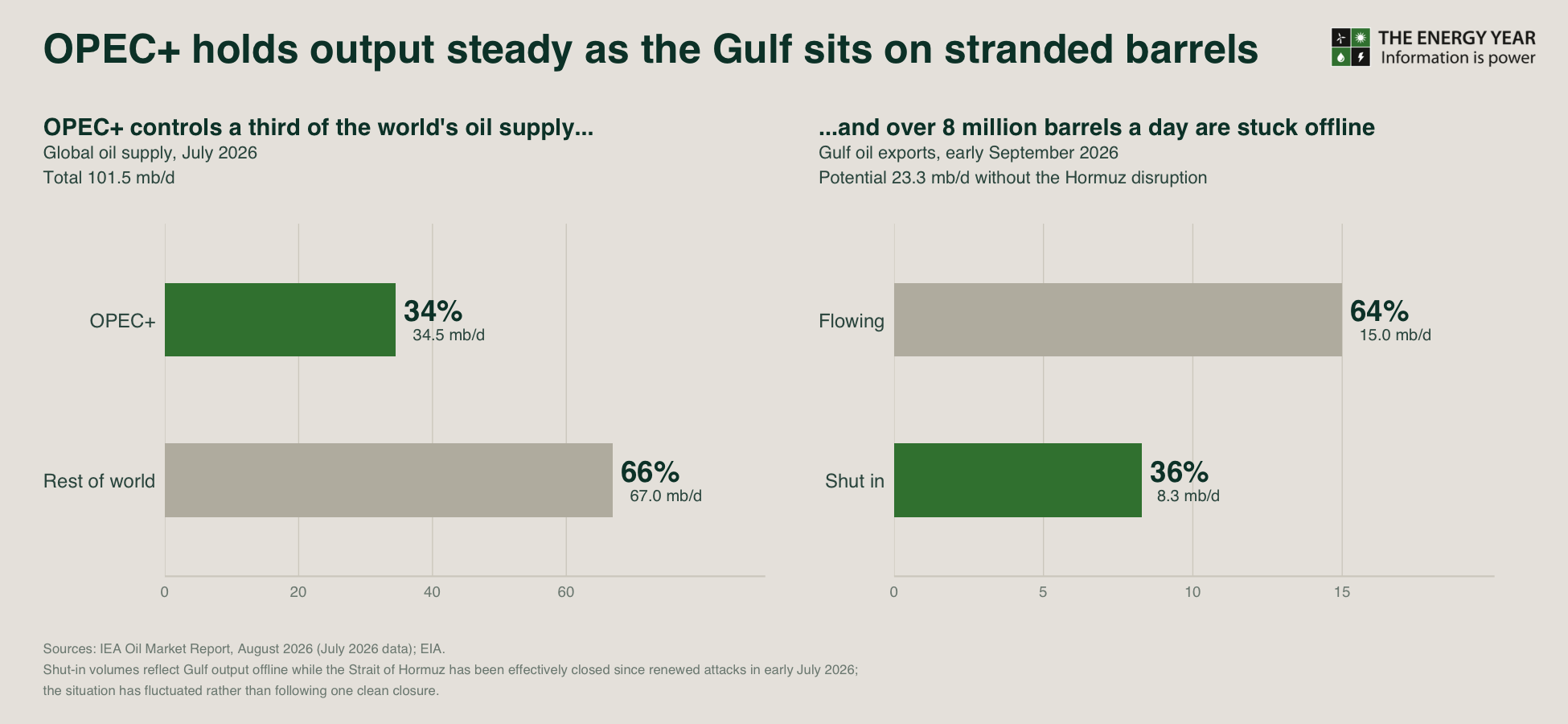
Graph: The Energy Year
Rather, the problem is one of getting their products to the market. The well-known chokepoint at the Strait of Hormuz is estimated to be preventing 8.3 million bopd, or 36% of Gulf oil, from reaching global markets. Similarly, Russia has faced difficulties in exporting oil since the war in Ukraine started in 2022.
The group’s next meeting on October 4 is expected to focus less on monthly output tweaks, and more on the broader review of members’ production capacity – the basis for setting 2027 quotas.